
SaaS Recruitment Australia Why Bluebird Operator-Led Model Stands Out
Last Updated: June 2026 | By James Bergl, Managing Partner APAC, Bluebird
The Australian SaaS hiring market in mid-2026 is more selective than it has been at any point in the past four years. Hiring managers are not moving slower because they are cautious; they are moving slower because the cost of a mis-hire has become impossible to ignore. Operator-led recruitment, where the person running your search has lived the role they are placing, is now the clearest way to reduce that risk and get the right person through the door faster.
What Makes SaaS Recruitment in Australia Feel Different Now
Anyone who has tried to hire a strong Account Executive or a Head of Sales in Sydney or Melbourne over the past 12 months will tell you the market is genuinely tight. Overall hiring in Australia is stabilising, but specialist tech talent remains in high demand while the pool of candidates who actually understand SaaS-specific context, things like ACV, quota design, sales motion, and ramp expectations, stays narrow.
I have been hiring SaaS teams in Australia since 2013. When I joined as founding AE at Datto, we built from zero to $40 million in turnover and 130 staff in six years. The hiring decisions at each stage of that journey shaped everything: culture, ARR trajectory, NRR, and churn. I saw first-hand that a single bad executive hire could set a commercial team back by 12 months.
The Australian SaaS market reached approximately USD 29.4 billion (roughly AUD 44.5 billion) in recruitment revenue in 2024, making it the second-largest recruitment market in APAC, according to Staffing Industry Analysts. That scale means more agencies competing for the same roles. What it does not mean is that more agencies understand the difference between a hunter AE and a farmer AE, or why a VP of Sales who succeeded at a Series D company may struggle badly in a Series A environment.
The Shift Toward Deliberate, High-Signal Hiring
By early 2026, the pattern across Sydney and Melbourne SaaS companies became clear: organisations are no longer hiring broadly. They are hiring deliberately, prioritising candidates who can solve a specific problem rather than fill a seat. Strategic workforce planning is now central to executive decision-making in a way it was not three years ago.
For a recruitment partner, that shift creates a real test. Generalist agencies can fill volume. They struggle when a hiring manager needs someone who can tell them, from lived experience, whether a candidate who carried a $2 million quota at a mid-market SaaS is ready to step into an enterprise motion with an 18-month sales cycle.
Why Technical Literacy Is Now a GTM Requirement
One trend reshaping every SaaS search I run right now is the demand for technical literacy across commercial roles. In 2026, technical literacy is no longer confined to Solutions Engineering; it is now an essential baseline for Account Executives and even Sales Development Representatives in complex SaaS environments. Candidates with backgrounds in technical support, IT architecture, or engineering are gaining a clear competitive edge in the market.
When I screen a candidate, I am not just checking their quota attainment number. I am asking them how they navigated a multi-stakeholder deal involving a CTO and a DevOps lead, and whether they can explain the product's architecture at a level that earns credibility in the room.
Why Operator-Led Hiring Conversations Matter
Here is the practical difference between an operator-led search and a traditional recruitment process: the quality of the screening conversation.
A recruiter without SaaS experience will ask a candidate what their OTE was and whether they hit quota. I ask those questions too, but I also ask how they structured their territory, what their average ACV looked like, how they managed deals that slipped, and what their NRR contribution was on expansion accounts. Those questions surface the signal a hiring manager actually needs.
What Top Candidates Expect From a Recruiter
Top SaaS talent in Australia, especially at the Account Executive, Customer Success Manager, and VP Sales levels, is highly selective about who they engage with. They will not open up to someone who does not speak their language. When I call a candidate who has been carrying enterprise quota at a known SaaS vendor, they can tell within two minutes whether the person on the other end has done the job.
That credibility gap is real and it matters. It affects which candidates agree to be represented, which roles they take seriously, and how confidently a shortlist can be presented to a hiring manager. At Bluebird, every consultant on the APAC team has worked inside SaaS companies, not just placed talent into them.
The Cost of Getting It Wrong
The Bridge Group's research shows that AE ramp time has grown to 5.7 months on average in 2025, up 32% from 4.3 months in 2020. Average AE tenure is now around 2.2 years. For a VP of Sales, the numbers are even harder: the average tenure in SaaS sits at around 19 months, and a significant proportion of initial VP Sales hires do not make it through that window productively.
When you factor in recruiting costs, ramp time, lost pipeline during the gap, and the ripple effect on team morale, a single mis-hire at the VP level can cost well beyond 1.5 to 2 times annual salary, as Deloitte research has consistently noted. For a scaling SaaS business, that is not just a financial hit. It is a momentum problem.
| Metric | Industry Benchmark |
|---|---|
| AE ramp time (2025) | 5.7 months average |
| AE average tenure | 2.2 years |
| VP Sales average tenure | ~19 months |
| Mis-hire cost (senior roles) | 1.5-2x annual salary (Deloitte) |
| AE voluntary attrition rate | 20% median |
Verdict: Every month a senior SaaS role sits open or is filled with the wrong person is a direct hit to ARR, NRR, and team stability. Operator-led screening materially reduces that risk.
What Bluebird Focuses On Across SaaS Roles
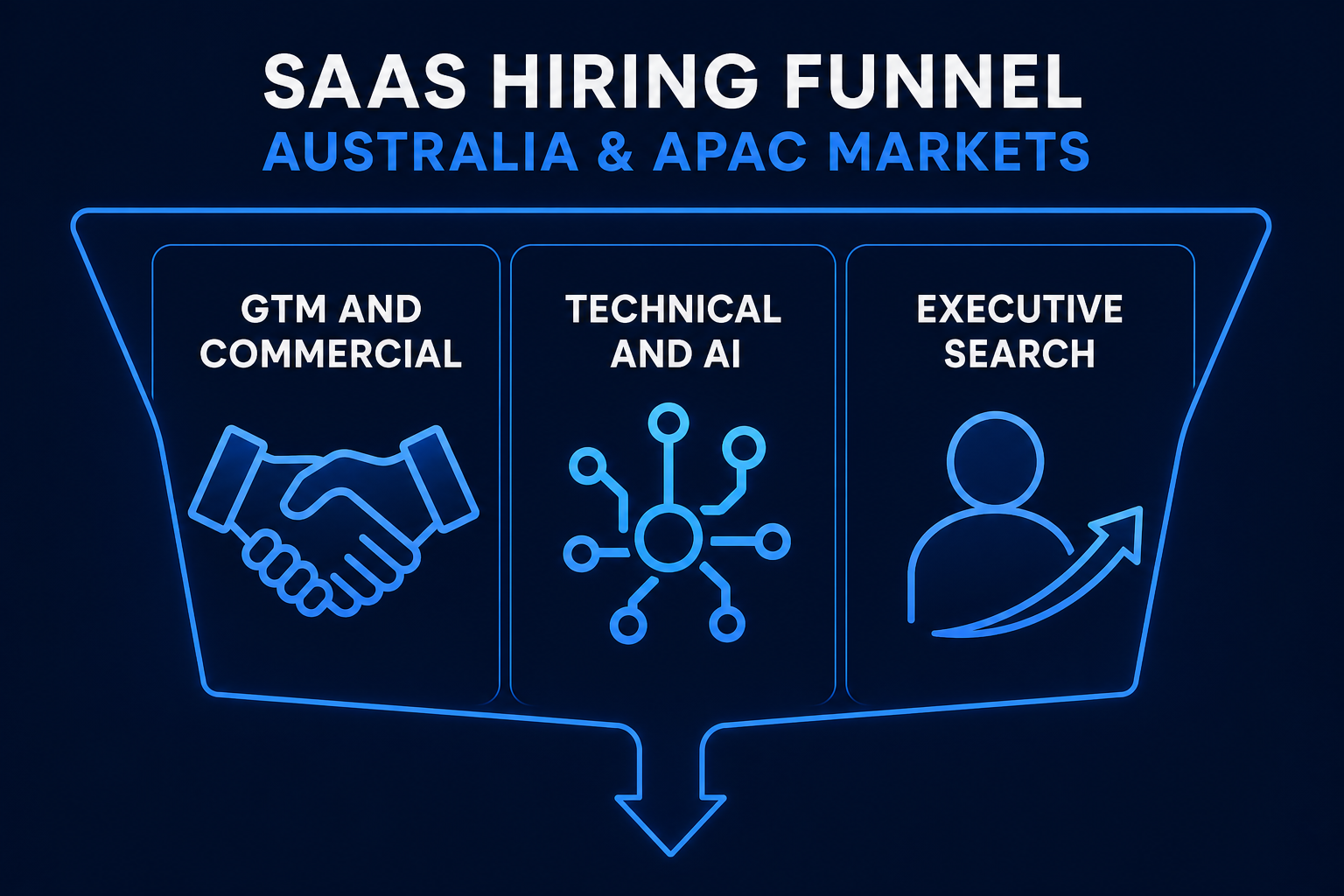
Bluebird specialises across three core hiring categories for SaaS companies in Australia: go-to-market talent, technical and AI roles, and executive search. Each category requires a different lens, and we staff each accordingly.
Go-to-Market and Commercial Hiring
GTM hiring covers the roles that directly touch revenue: Account Executives, Sales Development Representatives, Business Development Managers, Customer Success Managers, Revenue Operations leads, and sales leadership up to VP and CRO level. These are the hires where SaaS-specific context is most important and where generalist agencies most commonly fall short.
I focus heavily on understanding the company's sales motion before a search begins. A product-led growth company hiring its first outbound AE needs a very different profile from a traditional enterprise SaaS vendor looking for a senior enterprise rep. Getting that brief wrong at the start wastes everyone's time.
Technical and AI Talent
Demand for AI engineers, machine learning specialists, and technical leaders has grown sharply in the Australian market through 2025 and into 2026. We recruit for these roles with consultants who have engineering or technical product backgrounds, applying the same operator-led logic: the person running the search has to understand the work.
For technical roles, this means being able to read a job specification critically, ask a candidate meaningful questions about system design or stack decisions, and give a hiring manager an honest assessment of whether a candidate's background genuinely fits the engineering environment they are building.
Executive Search
For executive placements, including CEOs, CROs, CTOs, and CMOs at SaaS companies in Australia, we run a retained search model that allows for a focused, milestone-based process. The approach is designed for roles where a mis-hire is genuinely costly and where speed-to-quality matters more than speed-to-shortlist.
Leadership candidates at this level expect the search partner to understand board dynamics, equity structures, and what "great" looks like at different company stages, not just submit a CV and wait.
How Bluebird Frames Australia and Beyond Hiring
A meaningful portion of Bluebird's work in APAC involves helping international SaaS companies enter the Australian market for the first time, or helping Australian-founded software businesses expand into broader APAC markets including Singapore, Japan, and New Zealand.
This is a category where recruitment and GTM strategy overlap heavily. A US or European SaaS vendor entering Australia for the first time does not just need to fill a role. They need to understand the local buyer, the channel landscape, competitive pricing dynamics, and the talent pool they are drawing from before they commit to a hire.
Why Local Market Knowledge Changes the Conversation
I relocated to Australia from the UK with N-able in 2013 and then spent six years building Datto's ANZ business from the ground up. Before joining Bluebird, I helped launch Pax8 across APAC, growing to more than 2,000 partners and 160 staff within two years. That background is not decorative. It shapes every conversation I have with a founder or VP about what a realistic hiring plan looks like for this market.
Australia has genuine differences in buyer behaviour, sales cycle expectations, and compensation norms compared to the US or UK. An AE who excelled in a North American mid-market motion may take significantly longer to ramp here, or may need a different sales methodology altogether. Surfacing those risks at the brief stage rather than after a hire goes wrong is part of the value Bluebird brings.
Thinking about entering the Australian market or scaling your existing SaaS team? Contact us to talk through your hiring plan before you commit to a role spec.
Contingent Versus Retained Search: Choosing the Right Model
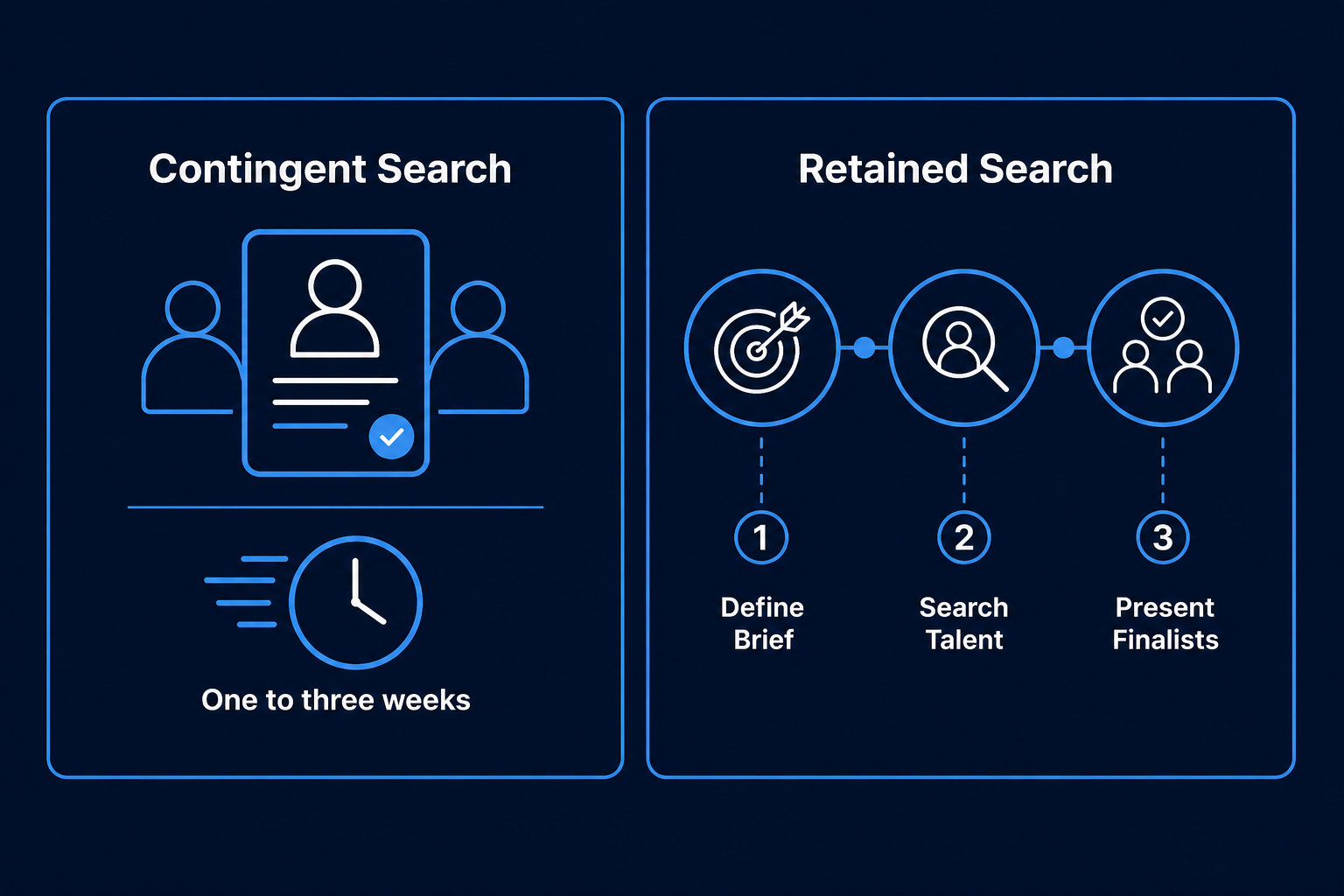
For most individual contributor hires, including SDRs and Account Executives, a contingent model works well: no upfront commitment, a pre-qualified shortlist delivered within one to three weeks. For mid-to-senior GTM hires and executive placements, a retained search provides dedicated focus, milestone-based delivery, and the kind of market coverage a critical role deserves.
Neither model is universally correct. The right choice depends on role seniority, urgency, and how much damage a mis-hire or extended vacancy would do to the business. We frame that conversation at the start of every engagement, not after the invoice arrives.
| Search Model | Best For | Timeline |
|---|---|---|
| Contingent | SDRs, AEs, CSMs, individual contributors | 1-3 weeks to shortlist |
| Retained | VP Sales, CRO, CTO, C-suite, senior GTM leads | Milestone-based, thorough market coverage |
Why This Approach Feels More Practical to Buyers
I want to be honest about what operator-led recruitment is and what it is not. It is not a magic guarantee. There are no perfect hires, no matter how thorough the brief or how rigorous the screening process. SaaS companies change, markets shift, and candidates evolve.
What the operator-led model does reliably is reduce the information gap between a hiring manager and the person running the search. When I tell a founder that a candidate is ready for an enterprise motion or that their stage-fit looks off, that judgement comes from having hired and managed similar teams across multiple SaaS businesses in Australia. It is not a resume read.
What Hiring Managers Notice First
Most hiring managers who work with Bluebird for the first time mention the same thing: the quality of the brief conversation. When the recruiter already understands the difference between an inbound-heavy role and a true outbound hunter, or knows why OTE structure matters as much as base salary for AE attraction in Australia, the whole process moves faster and with less back-and-forth.
We also try to give an honest view of the talent market. If a company's brief is unrealistic for the current market, we will say so rather than start a search that will fail. That kind of directness is not universal in the recruitment industry, but it is how experienced SaaS operators tend to approach problems.
The Practical Benefit for APAC Expansion Leaders
For global SaaS companies entering Australia, the operator-led model offers a specific advantage: access to a recruiter who can brief a North American or European leadership team on the real shape of the Australian market, not just confirm the role spec back to them. That includes salary benchmarks, realistic ramp expectations, pipeline maturity timelines, and the competitive dynamics around the talent pool.
Bluebird publishes an annual SaaS salary guide for Australia covering AEs, Sales Leaders, SDRs, Customer Success, and Marketing roles. That data is drawn from live market placements, not aggregated survey responses, which makes it more reliable for actual hiring decisions.
Frequently Asked Questions
What makes SaaS recruitment in Australia different from generalist recruitment? SaaS recruitment requires screening candidates on SaaS-specific context: ACV, quota design, ramp expectations, sales motion, and stage fit. Generalist recruiters typically lack the domain knowledge to assess these factors accurately.
How long does a typical SaaS search in Australia take with Bluebird? For individual contributor roles, a pre-qualified shortlist is typically delivered within one to three weeks. Senior GTM and executive searches run on a retained, milestone-based model and take longer depending on seniority and market depth.
Does Bluebird recruit outside of Sydney and Melbourne? Yes. While Sydney and Melbourne are the primary hubs for SaaS talent in Australia, Bluebird recruits nationally and across the broader APAC region, including Singapore, Japan, and New Zealand.
What role types does Bluebird specialise in for SaaS companies? Bluebird covers Account Executives, SDRs, Customer Success Managers, Sales Leaders, Revenue Operations, AI and technical roles, and C-suite executive search including CRO, CTO, and CEO placements.
Is operator-led recruitment more expensive than a traditional agency? Fees are competitive with the market. The return on investment comes from a reduction in mis-hires, faster ramp times, and higher retention. A single avoided mis-hire at the VP level more than recovers the cost of a retained search.
James Bergl is Managing Partner APAC at Bluebird and Co-Founder of Bluebird Talent Asia Pacific. He has spent more than 15 years in SaaS sales leadership across Australia and APAC, including founding roles at Datto ANZ and Pax8 APAC. He joined Bluebird in March 2024 to bring operator-led hiring to Australian SaaS companies and international vendors entering the region. Connect with James at bluebirdtalent.com.au.