
Sales Recruitment Australia What Changes When You Hire for SaaS
SaaS sales hiring in Australia operates by a different set of rules than traditional sales recruitment. The roles carry subscription-model metrics, stage-specific expectations, and a talent pool that is genuinely thin at the top. Getting the shortlist wrong does not just slow down the quarter — it can set back an entire go-to-market motion.
Why SaaS Hiring Asks for a Different Shortlist
When a software company opens a sales role, the job title rarely tells the full story. An Account Executive at an early-stage SaaS vendor might be expected to generate pipeline, run demos, manage procurement, and feed product feedback to the founding team, all at once. At a Series C business, the same title means closing enterprise deals inside a defined territory with full inbound support. Treating those two briefs the same way is one of the fastest ways to waste a search.
SaaS sales roles are built around repeating revenue. That means every hire carries implications for ARR, net revenue retention, and churn — not just quota attainment. A candidate who thrived in a transactional, high-volume environment may struggle with the longer sales cycles and multi-stakeholder deals common in B2B SaaS. The Asia-Pacific SaaS market is projected to grow at a 20.94% CAGR between 2025 and 2029, which translates directly into competitive pressure for the same small pool of experienced sellers across the region.
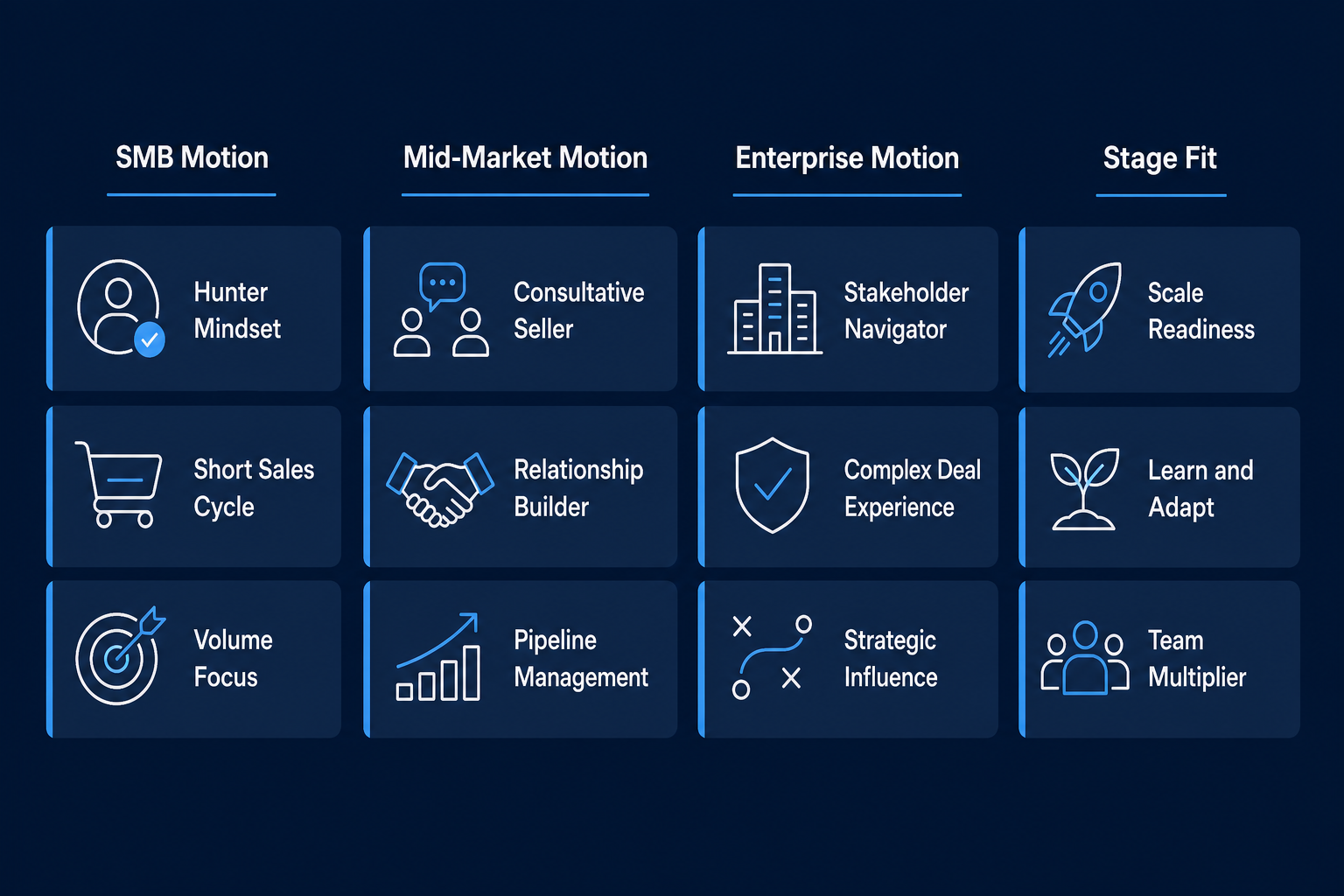
The shortlist criteria that work for sales recruitment in Australia's SaaS segment are specific. Recruiters need to screen for average contract values the candidate has closed, whether their experience maps to SMB, mid-market, or enterprise motion, and how they have handled longer sales cycles that now average 134 days in B2B SaaS — up 25% since 2022. A CV that reads well on surface metrics can still miss all three of those dimensions.
| Signal | What to Look For | What to Watch Out For |
|---|---|---|
| Deal size | ACV aligned to your ICP and pricing tier | High volume, low ACV only |
| Sales motion | Inbound-assisted vs. full pipeline ownership | Unclear split between inbound and outbound |
| Sales cycle | Experience with multi-stakeholder, 90+ day cycles | Only transactional or retail sales history |
| Company stage | Startup operator vs. enterprise process-follower | Stage mismatch relative to your current needs |
| Subscription metrics | ARR, churn awareness, NRR context | No awareness of retention economics |
What Australian Hiring Managers Usually Misjudge
The most common mistake is treating speed as the primary success metric. Every empty revenue seat does carry a real cost — but filling it with the wrong candidate costs considerably more. According to a 2025 SHRM report cited by UltraTalent, a single mid-to-senior bad hire costs a company an average of three to five times that person's annual salary when you factor in lost productivity, management time, and rehiring cycles.
The second misjudgement is underestimating role scope. Hiring managers often write briefs that describe what the role looks like at a more mature company than theirs currently is. The result is a search that looks for someone who has operated inside established process, when what the business actually needs is someone comfortable building from scratch. Those are very different candidate profiles, and confusing them wastes time for everyone in the process.
Candidate experience also matters more than many hiring teams acknowledge. Research consistently shows that top sales talent is evaluating the company as carefully as the company is evaluating them. In a market where experienced SaaS sellers are approached repeatedly, a slow or poorly structured process is enough to lose the shortlist to a competitor. The same applies to compensation design — sales development representatives and customer success managers in Australia now have clearer market benchmarks, and misaligned OTE structures will surface quickly in a competitive search.
How to Assess a Recruiter's SaaS Fluency
Not every agency that claims SaaS recruitment experience actually has it. The difference shows up quickly when you ask the right questions.
A recruiter with genuine SaaS fluency will talk about go-to-market motion before they talk about job titles. They will ask about your ACV, your sales cycle, your ICP, and where you are in your growth stage. If the first conversation is about job boards and application volumes rather than candidate calibration, that is a clear signal.
Here are the evaluation points worth testing:
- Can they define the difference between SMB, mid-market, and enterprise motion? And can they name why a candidate experienced in one may not transfer to another?
- Do they understand SaaS-specific metrics? ARR, churn, NRR, and quota attainment ratios should come up naturally in a capable SaaS recruiter's language.
- Have their consultants worked in SaaS themselves? Recruiters with direct operator backgrounds bring a different calibration lens to candidate assessment. They have seen the difference between someone who talks the talk and someone who has actually closed pipeline in a subscription business.
- Can they articulate ramp expectations honestly? A good SaaS recruiter will flag when your ramp timeline is misaligned with market norms, rather than just agreeing to your brief to start the search.
- Do they run retained or contingency search? For senior go-to-market and executive search roles, a retained search model signals a more committed, structured process.
Generic sales recruiters often screen for quota attainment and industry sector. SaaS-specialist recruiters screen for environment fit — whether a candidate's previous company stage, motion, and metrics are genuinely comparable to what you are building.
Why Location Still Matters in Australia
Australia's SaaS talent market is not evenly distributed. Sydney carries the heaviest concentration of enterprise software companies, regional headquarters, and experienced go-to-market professionals. A search for a senior Account Executive or VP of Sales that ignores Sydney's specific talent dynamics will take longer and produce a weaker shortlist.
A sales recruitment agency in Sydney with active relationships in the local market can reach passive candidates who are not applying to roles but who are open to the right conversation. Those profiles rarely show up on job boards. The Sydney market is also one where the same experienced sellers are approached repeatedly, which means process quality and employer brand matter more than in a deeper talent pool.
Melbourne is a genuine secondary market for SaaS sales hiring, with demand particularly strong in fintech, HR tech, and vertical SaaS. Brisbane and other capital cities are relevant for customer success and inside sales roles at companies with distributed teams. But for senior GTM and executive search, the Sydney network remains the sharpest entry point into the Australian SaaS talent market.
Remote and hybrid flexibility has expanded the search radius somewhat. Around 36% of Australians regularly work from home, and many SaaS companies are now open to candidates who can operate from outside major metros if the right talent is there. That said, for roles that require regular stakeholder presence, client entertainment, or cross-functional leadership, proximity to a major hub still matters in the day-to-day execution of the job.
How Bluebird Supports Australia and Beyond Hiring
Bluebird is built specifically for software companies hiring in Australia and the broader APAC region. The team comes from SaaS operator backgrounds rather than traditional recruitment, which means conversations about role design, candidate calibration, and market conditions start from a shared understanding of how subscription businesses actually work.
The core hiring coverage spans go-to-market roles including account executives, sales development representatives, and customer success managers, through to executive search for CEOs, CTOs, and revenue leadership positions. For companies entering the Australian market from North America, Europe, or elsewhere in Asia, Bluebird also supports APAC market entry hiring — from the first local GTM hire through to building out a full commercial team.
The australia and beyond positioning reflects a practical reality in SaaS hiring: many of the companies Bluebird works with are not just filling a local role. They are establishing a regional presence, which means the first few hires carry outsized strategic weight. Getting the go-to-market entry right requires market knowledge that a generalist agency simply does not have.
For SaaS companies at Series A or later, the cost of a wrong hire in Australia is not just financial. A poor early GTM hire can distort the company's read of the local market, damage early customer relationships, and create a credibility gap that takes months to recover from. The right recruitment partner challenges assumptions about who is actually needed at this stage — rather than just delivering CVs that match a surface-level brief.
Bluebird's approach to SaaS and AI recruitment in Australia centres on shortlists that are genuinely calibrated to company stage, sales motion, and the realities of the local talent pool — not on volume. Whether the search is for an opening commercial hire in Sydney or an executive search for a regional leader, the framework stays the same: understand the business context first, then find the right person for that specific environment.
Frequently Asked Questions
What makes SaaS sales recruitment in Australia different from standard sales hiring? SaaS roles require candidates with subscription-model experience, specific deal-size alignment, and stage-fit. Standard sales backgrounds often miss these criteria, leading to underperforming hires.
How long does a typical SaaS sales search take in Australia? Specialist searches for mid-to-senior SaaS sales roles typically take 30 to 45 days. Senior executive or regional leadership searches may run longer depending on seniority.
Is Sydney the main market for SaaS sales talent in Australia? Yes. Sydney holds the deepest concentration of experienced SaaS sellers and GTM professionals. Melbourne is a strong secondary market, particularly in fintech and HR tech.
What questions should I ask a SaaS recruitment agency before engaging them? Ask about their experience placing roles at your company stage, whether their consultants have SaaS operator backgrounds, and how they assess candidate environment fit beyond title and quota history.
Can a recruitment agency in Australia help with broader APAC hiring? Yes, specialist agencies with regional networks can support hiring across Singapore, New Zealand, Japan, and Southeast Asia — particularly for companies using Australia as their APAC headquarters.