

SDR Hiring in Australia The Signals That Predict a Better Fit
Most bad SDR hires look fine on paper. The resume shows cold calling experience, the candidate interviews with energy, and the references come back positive. What breaks down is not always visible in the first conversation, and that is the real problem with how most SaaS companies approach sales development representative hiring in Australia today.
The Australian SaaS hiring market has grown sharply more competitive in recent years. With more US and global software companies establishing APAC footholds, the demand for capable, ramp-ready SDRs in Sydney, Melbourne, and Brisbane consistently outpaces available supply. That scarcity makes the cost of a wrong hire even steeper: a misfit SDR does not just underperform, they delay pipeline, frustrate account executives, and require a full replacement cycle that can run three to six months.
This article is for hiring managers and founders who want to move past resume-first hiring and understand the specific candidate signals, interview techniques, and structural mistakes that determine whether an SDR will actually perform in a SaaS context.
What SDR Hiring Should Solve For
Before you write a job description, you need to be clear about what the role is actually supposed to produce. That sounds obvious. In practice, many teams conflate outputs (meetings booked) with role design (inbound qualification versus outbound prospecting versus both), and that confusion creates misaligned expectations from day one.
A well-scoped SDR role in a SaaS business is built around one clear function: feeding qualified pipeline to account executives at a rate that sustains growth targets. Everything else, the tools used, the sequences run, the verticals covered, sits downstream of that core purpose.
In the Australian market specifically, a few contextual realities shape what that means in practice:
- Market familiarity matters more than raw activity. Australian B2B buyers in sectors like fintech, legal tech, and construction software respond differently to outreach than US or UK prospects. An SDR who has worked exclusively in offshore contexts often struggles to read local buying signals or navigate relationship norms.
- The AE-to-SDR ratio is often tighter. Many Australian SaaS teams run with one SDR supporting two to three account executives. That means there is less room for a slow ramp or inconsistent output than there might be in a larger US team.
- Inbound is thinner. For companies entering the Australian market, brand awareness is lower. SDRs need genuine outbound capability, not just a comfort with responding to warm leads.
When you are clear on what the role needs to solve, you can evaluate candidates against an actual standard rather than a general impression.
The Signals That Matter Most in Candidates
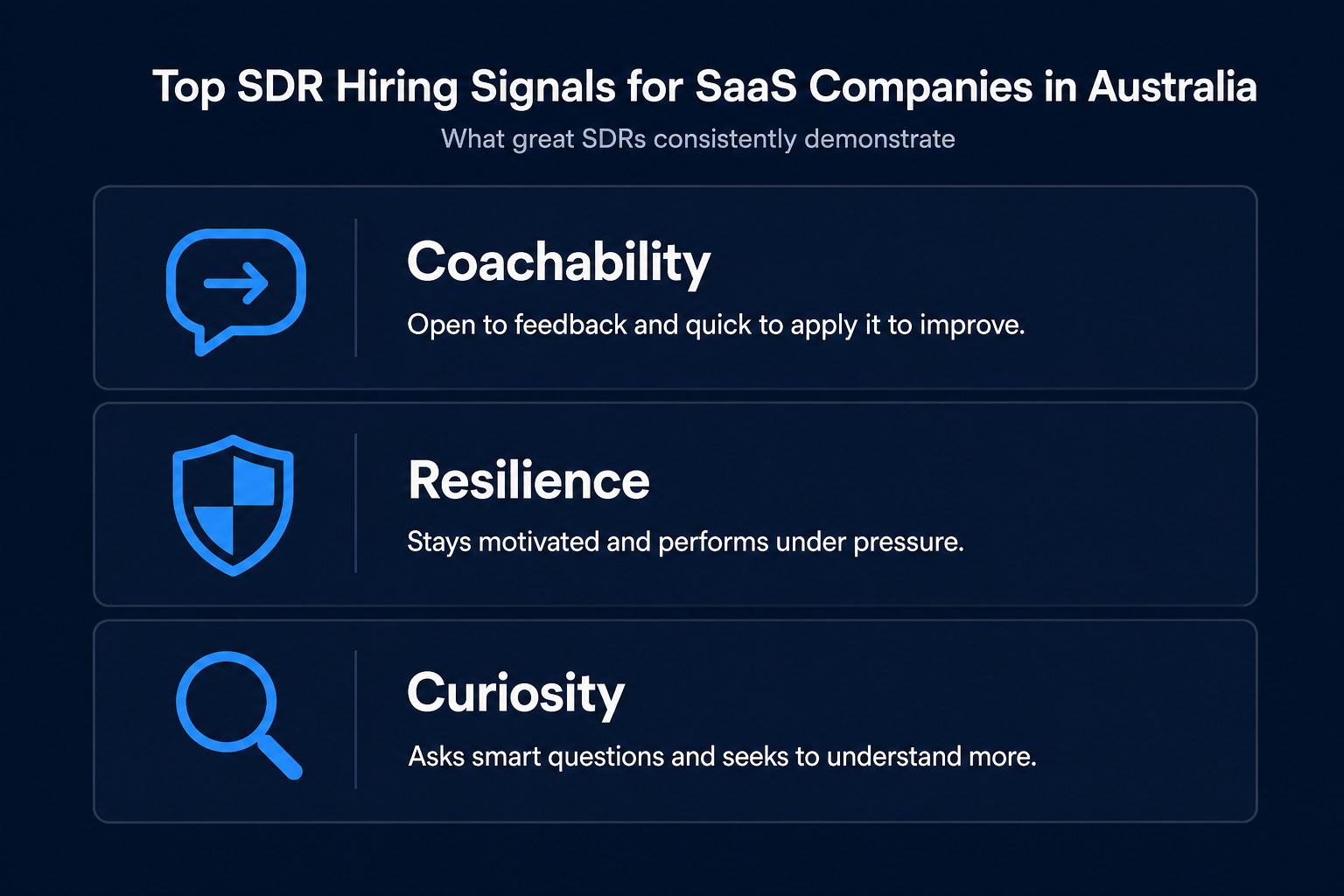
Hiring research consistently points to three behavioural traits that predict SDR success: coachability, resilience, and curiosity. The challenge is that all three are easy to perform in an interview and hard to fake in the role. Knowing how to distinguish authentic signals from polished ones is where the real work is.
Coachability
Coachability is not about agreeing with feedback. It is about processing feedback quickly and changing behaviour in the next repetition. A coachable SDR hears that their cold call opening is too product-focused on Monday and adjusts by Tuesday. An uncoachable one nods, says they understand, and makes the same call on Thursday.
The signal to look for in an interview is not whether a candidate describes themselves as coachable. It is whether they can give you a specific, recent example of feedback they received, explain why it was accurate, and articulate what they did differently as a result. Candidates who struggle to recall genuine feedback moments, or who frame all feedback as external validation they already agreed with, often lack real coachability.
Resilience
SDR roles carry a rejection rate that most roles do not. A candidate who interviews with energy is not necessarily a candidate who will make calls on a quiet Friday when the last three conversations ended in a hang-up. Resilience, in a practical sense, is about maintaining output discipline during extended low-signal periods.
Look for evidence of consistency in high-repetition, rejection-heavy environments from outside sales entirely. Strong SDR candidates often come from backgrounds in competitive sport, customer-facing service roles, or commission-only work where they have already built a personal system for managing setbacks. According to research on SDR competencies, the five traits that consistently predict SDR success are prospecting ability, resilience under rejection, coachability, communication quality, and intrinsic drive.
Curiosity
Curiosity is the trait most often underweighted in SDR hiring, and the one that most differentiates good performers from great ones. In a SaaS context, curiosity drives better pre-call research, sharper discovery questions, and faster ramp time as the SDR learns the product and market. A curious SDR asks a prospect a follow-up question after an objection. A non-curious one reads the next line of their script.
The interview signal here is preparation quality. Did the candidate research your company beyond the homepage? Do they have a view on your ICP, your competitive positioning, or a recent piece of your content? A candidate who arrives with genuine questions about how you go to market is showing you the same behaviour they will bring to prospect conversations.
| Signal | What to look for | What to avoid |
|---|---|---|
| Coachability | Specific feedback examples with behaviour change | Generic "I love feedback" statements |
| Resilience | Evidence of consistency in high-rejection environments | High energy only, no system for setbacks |
| Curiosity | Pre-interview research, genuine product questions | Vague interest, no preparation depth |
| Prospecting discipline | Process descriptions, not just activity metrics | Volume claims without structure |
How Interviews Should Test SDR Fit
The most common interview mistake in SDR hiring is optimising for conversational rapport rather than role-relevant evidence. A candidate who interviews well is not necessarily a candidate who will perform. The interview format should create conditions that reveal how the person actually thinks and acts, not how they present.
A few structured approaches that generate real signal:
Behavioural questions with follow-through. Ask the candidate to describe a specific situation where they lost a deal or failed to book a meeting they expected to book. Then ask what they did the next day. The follow-through is where the resilience signal lives, not in the initial story.
Live role-play with a specific brief. Give the candidate a one-paragraph ICP description and two minutes to prepare, then ask them to cold call you. This is not about polish. You are watching for how they recover from your first objection, whether they ask questions or pitch, and whether they can think on their feet without a script. The SDR interview process should always include a cold-call exercise, an objection-handling scenario, and an email-writing test.
Research quality check. Before the interview, send the candidate a brief with your product, a target vertical, and a named company in that vertical. Ask them to come prepared with three observations about that company's likely pain points and how they would approach the first outreach. What they bring tells you more about their curiosity and preparation habits than almost any question you can ask.
Structured scoring. Use a consistent scorecard across all SDR candidates. Rate each competency, coachability, resilience, curiosity, prospecting discipline, and communication quality, on evidence gathered in the interview, not on overall impression. Teams that score on gut feel introduce significant bias and make it harder to compare candidates fairly.
One practical note for hiring managers: the role-play is often the moment where a candidate's true confidence level shows. Some candidates who interview smoothly become hesitant when asked to perform. Some who seem nervous in conversation become sharp and focused when given a task. Neither initial impression is the accurate one.
Where Teams Misread Junior Revenue Talent
Hiring mistakes in the SDR function tend to cluster around a few repeating patterns. Recognising them before they happen is more useful than diagnosing them after a six-month mis-hire.
Mistaking energy for resilience. High-energy candidates are engaging to interview. But energy is a trait that shows up in good conditions. Resilience is what shows up on the days with a full inbox, a quiet phone, and two no-shows. They are not the same thing, and energy alone does not predict whether someone will maintain output discipline across a difficult quarter.
Overweighting industry experience. In Australian SaaS hiring, there is a tendency to prefer candidates with direct SaaS SDR experience, even when the talent pool of people with that specific background is shallow. Candidates from adjacent backgrounds, hospitality, teaching, competitive sport, or high-volume customer service, often carry stronger foundational traits and ramp faster than those with patchy SaaS experience who coasted in their previous role.
Conflating polish with performance. A candidate who speaks confidently about sales methodology, references MEDDIC or BANT fluently, and has done SDR training programs is not automatically a strong performer. Methodology knowledge is easy to acquire. The willingness to make seventy calls on a Wednesday when nothing is converting is not.
Skipping reference checks on the right questions. Most reference checks ask about reliability and work ethic in general terms. For SDR roles, the specific questions that generate useful signal are: how did this person respond to a period of underperformance? How did they take feedback from their manager? Would you hire them specifically for an outbound SDR role again? The last question, in particular, tends to produce honest answers.
Building the role around a ramp that never happens. Some teams hire an SDR and then spend the first three months waiting for them to be ready, rather than building a structured ramp with clear weekly targets, regular call reviews, and defined coaching cadences. An SDR without a structured ramp rarely succeeds, regardless of how strong the hire was.
It is also worth noting that the Australian SaaS hiring market rewards companies with clear progression paths. According to data from the Australian job market, the average SDR role in Australia closes in approximately 34 days, which is a relatively short window to make an informed hiring decision. Companies that move too fast without structured evaluation often pay for it over the following two quarters.
| Common mistake | Why it happens | What to do instead |
|---|---|---|
| Mistaking energy for resilience | Interviews surface performance, not pressure | Use live role-play and ask about specific hard periods |
| Overweighting SaaS experience | The local talent pool is shallow | Assess traits first, domain knowledge second |
| Skipping structured scoring | Teams hire on gut feel | Build a competency scorecard before the first interview |
| Weak reference questions | Generic references give generic answers | Ask specifically about rejection response and coachability |
| No structured ramp | Assumption that the hire will figure it out | Define week-by-week targets before day one |
How Bluebird Supports SDR Hiring Decisions
Bluebird works specifically with SaaS companies building go-to-market and revenue teams in Australia and the broader APAC region. That focus matters in SDR hiring because the signals that predict success in a SaaS context are different from those in traditional sales roles, and the Australian market adds another layer of specificity on top of that.
The Bluebird team comes from SaaS backgrounds rather than generalist recruitment. That means the screening process for sales development representatives is built around the competencies that actually predict SDR performance: coachability, outbound discipline, resilience, and product curiosity. Not whether a resume shows two years of SDR experience at a company that may or may not have been a functional team.
For companies entering Australia for the first time, Bluebird also brings relevant local market knowledge. Understanding which candidate backgrounds translate well into SaaS SDR roles in Sydney versus Melbourne, which compensation structures are competitive in the current market, and how to position a brand-new Australian SDR role attractively to candidates who have options, all of that sits inside the brief rather than outside it.
For scaling SaaS teams, the support extends beyond sourcing. Bluebird works with hiring managers to define the right role scope before the search begins, which is often where the most consequential decisions are made. Scoping the wrong SDR role is expensive regardless of how well it is filled.
If you are building an SDR function in Australia for the first time, or replacing a hire that did not work out, the conversation worth having is about role design and candidate signals before it is about job boards and application volume.
Frequently Asked Questions
What is the biggest hiring mistake companies make when hiring SDRs in Australia? Mistaking a polished interview performance for genuine resilience and coachability. These traits require structured assessment, not just a conversation.
Do Australian SDR candidates need prior SaaS experience? Not necessarily. Traits like coachability, curiosity, and outbound discipline are stronger predictors. Adjacent backgrounds often ramp well in SaaS SDR roles.
How long does it take to fill an SDR role in Australia? Approximately 34 days on average based on current Australian job market data. Structured evaluation inside that window is essential to avoid a costly mis-hire.
What interview format works best for SDR hiring? A combination of structured behavioural questions, a live cold-call role-play, and a pre-interview research task. Scoring on competencies, not overall impression.
When should a SaaS company use a specialist recruiter for SDR hiring? When entering Australia for the first time, when internal hiring has produced a mis-hire, or when speed and role design clarity are both critical to the outcome.