

Sales Development Representatives Why They Are Still Hard to Hire Well
Hiring sales development representatives is one of the most deceptively difficult tasks in a SaaS go-to-market build. The role looks simple on a job description, but the gap between a candidate who interviews well and one who actually produces pipeline is where most hiring mistakes live.
The Australian SaaS market has matured quickly over the last few years. Median SDR OTE now sits around A$95K for mid-level B2B SaaS roles, and top performers in sectors like cybersecurity and enterprise SaaS are clearing A$150K OTE. At those comp levels, a wrong hire is not just a missed quarter. It is a significant cost to the business, in ramp time, management attention, and pipeline gaps that compound over months.
This article covers where the real difficulty lies in SDR hiring, what separates strong candidates from convincing ones, how your interview process affects the outcome, and when it makes sense to look beyond the SDR label entirely.
Why SDR roles are easy to describe and hard to hire for
Every SaaS hiring manager knows what an SDR does on paper: outbound prospecting, cold outreach, pipeline qualification, booking meetings for account executives. The job description practically writes itself.
The problem is that the skills you are actually screening for are not on most resumes. Resilience under rejection, genuine curiosity about a prospect's business, and the discipline to run a structured sequence day after day are not credentials. They are behaviours, and behaviours are hard to surface in a 45-minute conversation.
There is also a structural challenge specific to the Australian market. The SDR talent pool here is smaller than in the US, where the role has been institutionalised for longer. Many candidates come from non-SaaS backgrounds, which is not disqualifying, but it does require more careful evaluation of whether their commercial instincts translate. According to Bridge Group's SDR Metrics research, annual SDR turnover globally runs between 34% and 40%, which means companies are often re-hiring the same role before the previous person has even fully ramped.
That churn rate reflects a systemic evaluation failure more than a talent shortage. Companies hire for communication skills and confidence, miss the activity discipline and coachability signals, and then attribute the outcome to the candidate rather than the process.
The gap between title and real requirements
An SDR role at a Series A startup entering the Australian market looks nothing like an SDR role at an established enterprise SaaS vendor in Sydney. One requires someone who can build an outbound motion from scratch, handle a poorly defined ICP, and stay productive without much structure. The other needs someone who can work a well-defined sequence inside a mature sales process.
Hiring managers often use the same job description for both and then wonder why the hire does not stick.
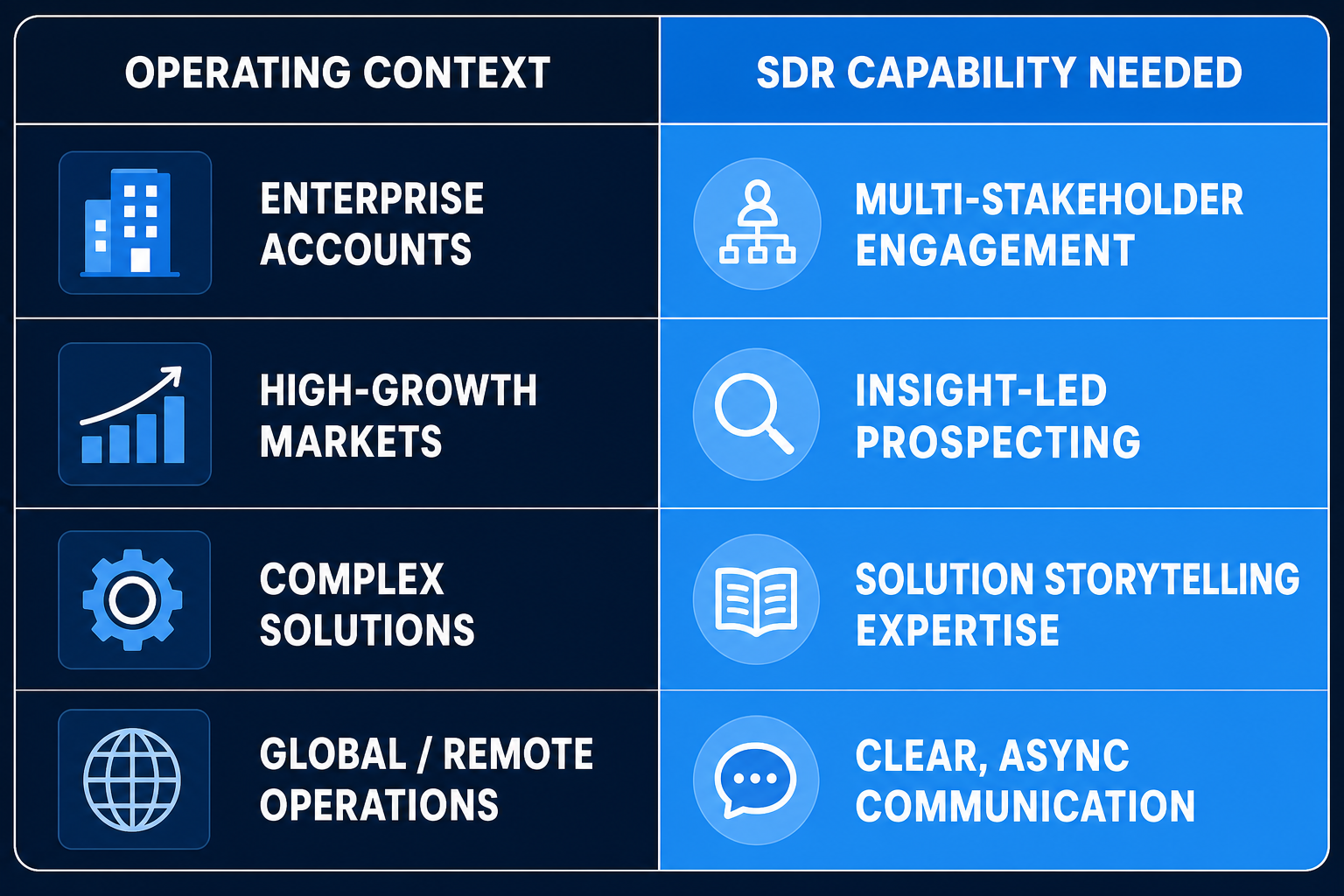
The smarter approach is to define the actual operating environment first: how much structure exists, what the SDR-to-AE handoff looks like, what the product complexity demands in terms of discovery, and what the realistic ramp timeline is. Those answers should shape everything from the candidate profile to the interview scorecard.
| Operating Context | Key SDR Capability Needed |
|---|---|
| Early-stage, undefined ICP | Self-direction, messaging experimentation, tolerance for ambiguity |
| Growth-stage, structured motion | Sequence discipline, speed to activity, coachability on feedback |
| Enterprise SaaS, long cycles | Multi-threading, stakeholder research, patience with longer ramp |
| APAC expansion, new market | Cross-cultural communication, local network building, adaptability |
What makes the best SDR candidates stand out
The candidates who perform consistently share a few traits that are not always obvious in a first interview. They are genuinely curious about problems, not just interested in talking. They run personal systems that keep their activity consistent when motivation dips. And they treat objections as information rather than rejection.
Activity discipline is probably the single strongest predictor of SDR success that is underweighted in most hiring processes. The Australian SDR market assumes around 5 to 8 live conversations per rep per day, with top performers reaching 15 to 20 through better list quality and smarter sequencing. That gap is not luck. It reflects habits and systems that good candidates have already built.
Curiosity matters for a different reason. A curious SDR will ask better questions in their outreach, adapt their messaging faster based on what they hear, and ramp more quickly on complex product areas. It also signals coachability, which is what separates the SDRs who grow into strong account executives from those who plateau.
Signals worth testing in the process
A few practical things to look for:
- Specificity in past examples. Strong candidates can tell you exactly how many calls they made per day, what their connect rate was, and what they did when numbers dropped. Vague answers about "hitting targets" are a yellow flag.
- How they handle live objection practice. A short, structured roleplay during the interview reveals more than two hours of competency questions. You are not looking for a perfect pitch. You are looking for composure, listening, and adaptation.
- Questions they ask you. An SDR who asks about the ICP clarity, the current pipeline health, or what the top reps do differently is already thinking like someone who wants to succeed in the role. One who only asks about commission structure is giving you signal too.
- Evidence of self-directed learning. Podcasts they follow, communities they are part of, or frameworks they have adopted on their own all indicate someone who grows without being pushed.
How interview process quality changes outcomes
Most SDR hiring processes are not rigorous enough to catch the difference between a good interviewee and a good SDR. A strong candidate can carry a conversation, project confidence, and give polished answers about their past. None of that tells you whether they will build pipeline in your specific environment.
Consistency is the first fix. If different interviewers ask different questions and score differently, you are not building a reliable signal. A structured scorecard applied consistently across all candidates does not remove judgment. It creates a framework for judgment that compounds over time, so each hire makes your evaluation more accurate.
The second fix is adding at least one practical component. A short prospecting brief, a cold email written live, or a five-minute mock cold call gives you observed behaviour rather than reported behaviour. These tasks also reveal how candidates handle pressure and ambiguity, which is exactly the environment they will work in.
Common process mistakes that cost good hires
Slowing down for the wrong reasons is a real risk. The Australian SaaS talent market moves quickly, and strong SDR candidates are often in multiple processes simultaneously. An interview process that stretches beyond three weeks without clear communication tends to lose the candidates you most want.
Conversely, moving fast without structure leads to confidence-driven hiring, where the most articulate candidate wins regardless of fit. The fix is a short, consistent process: two to three stages, a practical task, and a scorecard that separates evidence from impression.
According to Emergence Capital research across 560 B2B software companies, 36% of companies cut SDR headcount in the past year, the highest reduction rate of any sales role. That is partly a result of AI-assisted outreach tools absorbing some of the volume work. But companies still actively hiring SDRs are doing so because they understand that pipeline quality, not just pipeline quantity, comes from human judgment in early conversations.
What to expect from specialist support
Working with a recruiter who comes from a SaaS background rather than a generalist staffing background changes the quality of the brief. Someone who has hired or worked in GTM roles understands what "founding SDR" actually means, can benchmark your comp package against current Australian market data, and will tell you when your requirements are unrealistic for the candidate pool you are targeting.
Bluebird works exclusively in SaaS and AI recruitment across Australia and the broader APAC region. The team's background is in SaaS operations rather than traditional recruitment, which means the conversations around role scoping tend to be more commercially grounded. When a client is hiring their first SDR into an Australian market entry, the brief is rarely just about finding someone with experience. It is about finding someone who can operate without much infrastructure and still build pipeline.
Specialist support does not replace a strong internal hiring process. What it does is compress the front-end work: market mapping, passive candidate outreach, compensation benchmarking, and the early screening that filters for the non-obvious signals that matter. That compression is particularly valuable for companies hiring their first GTM hires in Australia, where local market knowledge makes a material difference.
What a good partnership looks like in practice
A useful specialist partner will push back on your brief when needed. If you are asking for three years of SaaS SDR experience in Australia at a comp level that does not match market rates, a good partner tells you that directly rather than just running the search and delivering thin shortlists. They will also help you structure the role progression, because candidates who see a credible path to account executive or a senior SDR track are more likely to commit for long enough to deliver real value.
When to expand the search beyond SDR labels
Not every pipeline problem is solved by hiring a traditional SDR. Some companies searching for sales development representatives would be better served by a different profile entirely, depending on where they are in their GTM build.
A business development representative with a slightly broader remit, a junior account executive who owns a smaller segment, or even a high-performing customer success manager who transitions into an expansion-focused outbound role can all create pipeline in ways that a narrow SDR search might miss. The Australian SaaS talent pool has strong candidates who do not carry the SDR title but have exactly the skills the role requires.
Adjacent profiles worth considering
BDR with inbound and outbound scope. If your motion is not purely outbound, a BDR who can handle both channels often ramps faster because they get early wins while building the outbound muscle.
Junior AE on a commercial or SMB patch. Some candidates who are over-qualified for an SDR role will accept a commercial AE role with a smaller deal size. This works especially well for companies that want pipeline generation and some closing capacity in the same headcount.
Customer success professional moving into GTM. Strong CSMs have existing skills in discovery, objection handling, and account context. With the right product knowledge and a structured ramp, they can generate high-quality pipeline in expansion motions. This is a particularly underused approach in SaaS sales recruitment for companies with an existing customer base.
Generalist with relevant domain knowledge. For vertical SaaS companies, a candidate with deep domain knowledge in the target sector and reasonable commercial instincts will often outperform a polished SDR with no context. The outbound mechanics can be taught. The credibility to have early conversations in a specialist market is harder to build.
The broader point is that go-to-market hiring in Australia benefits from a wider lens. The best outcome is not always the candidate who matches the job title. It is the person who can create qualified pipeline in your specific environment, at your specific stage, with the resources you actually have.
Frequently Asked Questions
What is the typical OTE for a SaaS SDR in Australia in 2026? Mid-level B2B SaaS SDRs in Australia earn a median OTE of around A$95K in 2026, with senior reps in Sydney and Melbourne reaching A$115K to A$130K OTE.
How long does it typically take to hire an SDR in the Australian market? A focused search with a clear brief usually takes four to eight weeks from briefing to offer acceptance, though moving too slowly in a competitive process risks losing strong candidates.
What is the most common mistake in SDR hiring processes? Relying too heavily on interview performance rather than observed, practical tasks. Communication skills do not reliably predict activity discipline or pipeline output.
Should I use a specialist recruiter for SDR hiring in Australia? For a founding GTM hire or a market entry role, specialist support with local SaaS market knowledge usually shortens the search and improves shortlist quality compared to generalist or job board approaches.
When does it make sense to look at BDR or junior AE profiles instead of a pure SDR? When your motion includes inbound qualification, when the deal size allows a junior AE to also prospect, or when your ICP requires domain credibility that a traditional SDR profile may not carry.