
How to Compare Melbourne Sales Recruiters Before You Sign Anything
Hiring the wrong Melbourne sales recruiter is one of the most expensive mistakes a SaaS hiring team can make.
Not because the fee is wasted, although it often is. Because the wrong partner costs you the candidates you actually needed.
A failed or underperforming hire in a revenue-generating role sets back a quarter at minimum and a full go-to-market motion at worst. The recruiter who caused it is long gone by the time that cost becomes visible.
This guide gives you a clear framework for comparing Melbourne sales recruitment agencies before you commit to any of them.
Why the Melbourne SaaS Hiring Market Requires a Specialist
Melbourne Is Expanding Its Tech Footprint
Melbourne is not simply a smaller Sydney in terms of SaaS and tech hiring. It is a distinct market with its own concentration of roles, talent supply dynamics, and sector strengths.
Talent International's 2026 workforce outlook shows Victoria entering 2026 with a broadly positive employment outlook, driven particularly by healthcare technology, product-led scale-ups, and digital infrastructure projects that are reinforcing commercial and engineering teams across the city.
SustainRecruit's 2026 hiring trends analysis confirms that Melbourne's product-led businesses are actively reinforcing commercial leadership to support expansion, with SaaS, enterprise platforms, and AI-enabled services among the most active hiring categories.
Melbourne's SaaS ecosystem has particular depth in property technology, logistics software, education technology, legal tech, and professional services platforms. Sellers from those backgrounds bring domain credibility that a generalist SaaS candidate often cannot match.
The Cost of Getting It Wrong Is Not Theoretical
SHRM's 2025 research on hiring costs puts the average cost of a bad mid-to-senior hire at three to five times that employee's annual salary.
For a senior account executive or sales leader in Melbourne, that figure reaches six figures very quickly. And that is before accounting for pipeline stalled, customer relationships damaged, and the management time diverted from building the business to managing an underperforming rep.
The decision about which recruiter to engage deserves the same rigour as the decision about which candidate to hire.
What Strong Melbourne Sales Recruitment Actually Looks Like
Specialist Depth, Not Generalist Reach
A specialist sales recruitment agency in Melbourne does more than post a job and forward CVs.
The best firms understand how SaaS revenue models work, what a realistic ramp looks like for an AE entering a new territory, how to distinguish a genuine quota-carrier from someone with a polished resume and a thin track record, and what the Melbourne-specific talent market expects from a competitive offer.
The bar is higher than most generalist agencies acknowledge. And it is almost impossible to reach without specific domain experience in the roles being recruited for.
What Genuine SaaS Recruitment Capability Looks Like
Role-specific candidate networks. Not job board applicants. Active relationships with SaaS sales performers across Melbourne who are known quantities, not just names in a database.
Benchmarking capability. Not general salary guides. Current intelligence on what candidates in Melbourne are actually accepting, broken down by role, seniority, company stage, and sector.
Assessment depth. Not a resume read and a phone screen. Structured evaluation of sales motion fit, deal complexity alignment, ACV history, stage experience, and ramp readiness.
Honest timelines. Based on actual candidate availability in the Melbourne market for your specific role type, not optimistic numbers designed to win the engagement.
A recruiter who has never held a SaaS sales or commercial role is working from theory. One who has is working from direct experience. That gap shows in the quality of the shortlist and the quality of the advice you receive when a search is not going well.
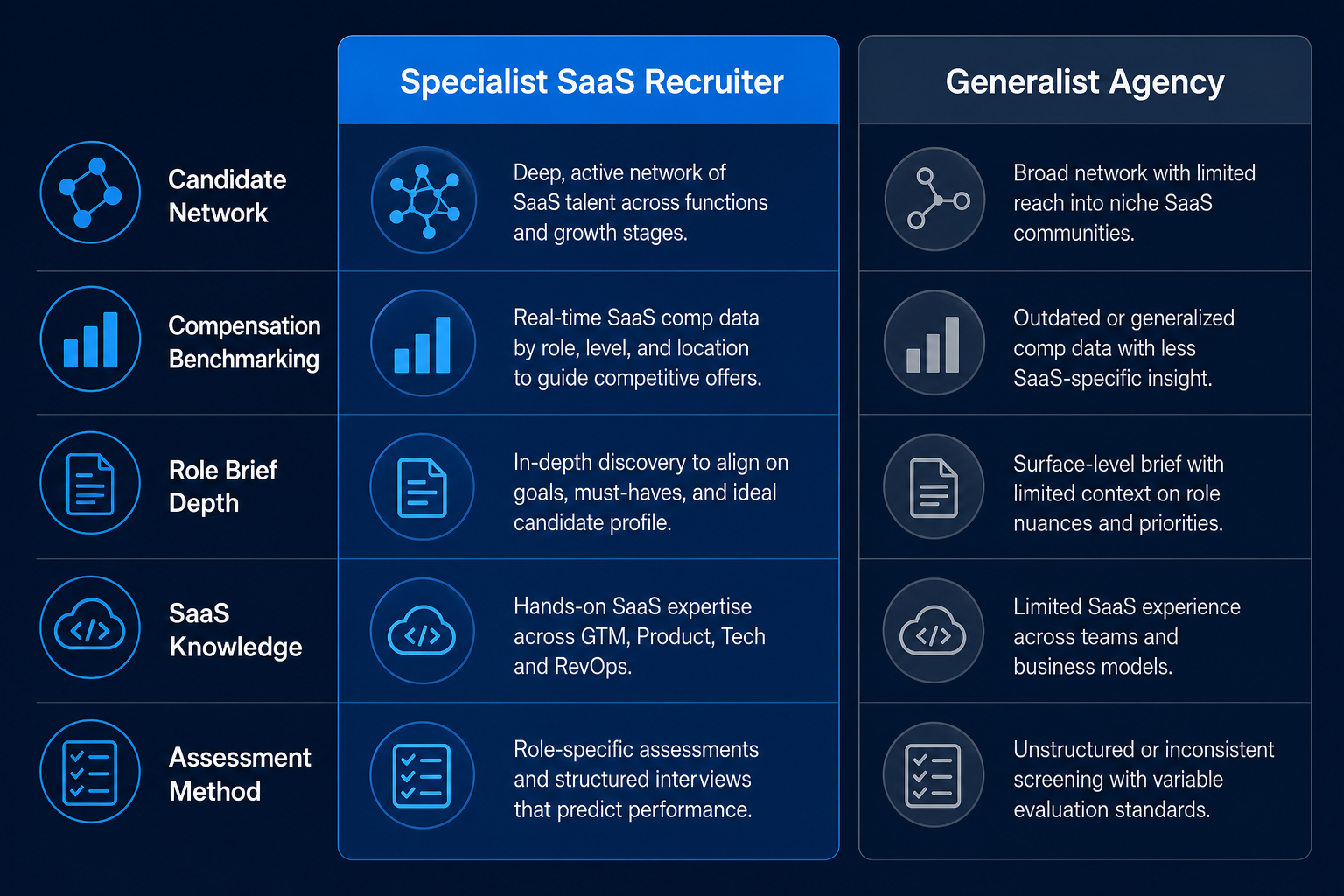
| Capability | Specialist SaaS Recruiter | Generalist Agency |
|---|---|---|
| SaaS revenue model knowledge | Strong: understands ARR, churn, NRR | Weak: treats sales as industry-agnostic |
| Candidate network | Pre-mapped SaaS performers in Melbourne | Broad database, lower SaaS density |
| Compensation benchmarking | Melbourne SaaS market-specific | General salary guides only |
| Role brief quality | Probes sales motion, territory, stage | Surface-level: title and responsibilities |
| Assessment depth | Evaluates ramp fit and deal complexity | CV screening and culture feel |
Where Melbourne Hiring Teams Waste Time
Vague Briefs Produce Vague Shortlists
The most common mistake I see Melbourne SaaS hiring teams make is treating the brief as optional.
A vague brief produces a vague shortlist. A generalist recruiter with a vague brief will almost always default to whoever is currently available and actively looking, not whoever is genuinely right for the role.
The brief session is where the search is really won or lost, before a single candidate has been contacted.
Engaging Too Many Agencies at Once
Splitting a brief across four or five firms creates a race-to-shortlist dynamic.
Agencies prioritise speed over fit, and you end up reviewing the same candidates from multiple inboxes with no clear process ownership. For specialist GTM roles, this approach consistently produces worse outcomes than a single committed partner with the right domain depth.
Accepting Volume as Proof of Progress
If an agency sends you eight candidates within 48 hours for a senior GTM role in Melbourne, that is a warning sign, not a positive.
Quality GTM searches involve targeted outreach to passive candidates. The best Melbourne account executives and sales leaders are not responding to job ads. They are responding to credible, specific, well-researched approaches from people who understand what they do.
A shortlist built in 48 hours from a database is a different product from a shortlist built over two weeks through targeted sourcing. They should not be evaluated the same way.
Skipping the Reference Check on the Agency Itself
Most hiring managers check candidate references carefully and skip agency references entirely.
Ask for two or three client references from companies in a similar stage or sector to yours. Call them. Ask specifically: did the shortlist reflect the brief accurately? Did the recruiter push back when the brief needed it? How were problems communicated during the search?
Those answers will tell you more than any agency website.
The Questions to Ask Before You Sign Anything
These questions separate firms that genuinely understand your hiring context from those that are filling a slot in their pipeline.
On Domain Knowledge
What SaaS companies have you placed account executives or sales leaders with in Melbourne in the last 12 months?
How do you assess whether a candidate's prior sales motion maps to ours specifically?
What does a realistic ramp timeline look like for this role type in the current Melbourne market?
On Sourcing and Process
How many candidates will you actively approach, and what does that outreach look like?
At what point will you flag if our compensation structure is misaligned with what Melbourne candidates are currently accepting?
Who on your team will personally run this search, and what is their SaaS background?
On Commitment and Accountability
Are you proposing retained search or contingency? What are the practical differences in how you will prioritise this role?
How do you handle situations where the shortlist is not resonating after two rounds?
What does your replacement guarantee look like if the placed candidate does not work out?
Red Flags in the First Conversation
- Timeline guarantees before they have understood the role context
- No pushback on your brief, at all
- References only to total placements, not placements in your specific function or stage
- Inability to describe the Melbourne SaaS talent market from a candidate's perspective
- Fee discussion before role context discussion
How Melbourne Differs From Sydney as a Hiring Market
Two Markets, Two Talent Dynamics
The distinction between Melbourne and Sydney as SaaS hiring markets matters more than most interstate hiring managers expect.
Sydney has traditionally been the first landing point for US and UK SaaS vendors entering Australia, particularly in enterprise software, fintech, and cloud infrastructure. As a result, the Sydney SaaS sales talent pool has deeper exposure to large deal sizes, aggressive growth targets, and complex enterprise buying processes.
Melbourne's SaaS ecosystem has different strengths. The city has produced a strong base of mid-market and vertical SaaS companies across property technology, logistics, legal tech, education, and professional services software.
Melbourne sellers often have deeper experience with considered buying processes, multi-stakeholder deals, and change management requirements, which suits SaaS products requiring genuine implementation depth rather than fast transactional closes.
For a company deciding where to anchor its first Australian hire, understanding these differences matters before the search starts, not after. More detail on the Sydney side of this comparison is in the guide to Sydney sales recruitment.
Compensation Nuances Between the Two Cities
Melbourne and Sydney SaaS compensation benchmarks are close but not identical.
Sydney roles in enterprise SaaS with strong inbound motion tend to carry a slight premium due to the concentration of global vendor headquarters. Melbourne roles in vertical SaaS or mid-market motion often compete on base stability and career pathway clarity as much as on OTE.
A recruiter who treats both cities as interchangeable is not giving you an accurate market read. Push for specifics: what does the active candidate pool look like for this role type in Melbourne right now, and how does that differ from what you would expect in Sydney?
The 2026 SaaS Salary Guide covers city-by-city benchmarks for every core commercial role, built from Bluebird's own live placement data across both markets.
What This Means for Your Brief
If you are a US or European SaaS vendor entering Australia and starting in Sydney, candidates there may be more familiar with high-velocity pipeline models and inbound-assisted selling.
If you are building a Melbourne-first team for mid-market or vertical SaaS, you need a recruiter who understands that talent pool specifically and is not recycling a Sydney-sourced shortlist for a different market.
Hiring a sales role in Melbourne and want to understand what the current talent pool actually looks like for your brief? Get in touch here.
How Bluebird Approaches Melbourne Sales Hiring
At Bluebird, we recruit SaaS and AI commercial talent across Australia including Melbourne, operating from a practitioner background rather than a traditional staffing model.
That means the people running your search understand how a SaaS sales cycle works, what good customer success looks like in a recurring revenue business, and how to evaluate an AE against your specific motion rather than against a generic sales profile.
What Bluebird Is Built For in Melbourne
SaaS companies hiring their first GTM roles in Australia. Where getting the founding commercial profile right is critical and there is limited runway to recover from a mis-hire.
Scaling software companies building SDR, AE, or CS teams. Who need a recruiter that can assess recurring revenue competency, not just general willingness to work in sales.
International vendors entering the APAC market via Melbourne. Who need local intelligence on compensation, candidate expectations, and the specific talent dynamics that differ from Sydney.
Executive search. For VP Sales, CRO, or country-level leadership roles where domain fit and local network credibility both matter. Full details on executive search engagement are on the services page.
What the Engagement Looks Like
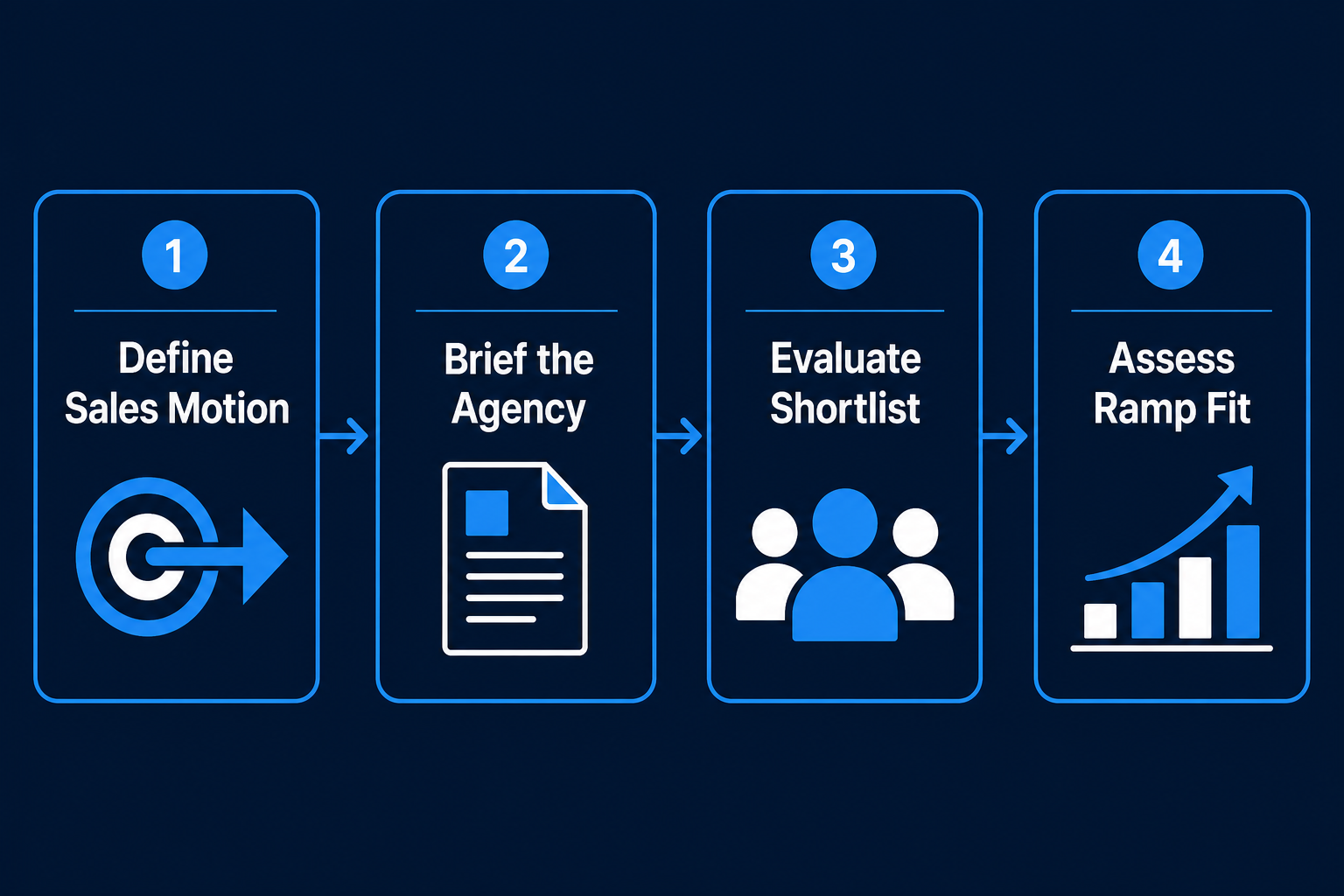
Every search starts with a proper brief session, not a form.
That session covers role scope, ICP definition, sales motion, stage fit requirements, compensation structure, ramp expectations, and what success looks like at 30, 60, and 90 days.
For mid-to-senior roles, I recommend a retained search model. It aligns incentives correctly, gives the search dedicated focus, and typically produces a stronger shortlist faster than splitting a contingency brief across multiple firms.
For individual contributor roles where speed is the priority, contingency works well if the brief is clear and the recruiter has genuine Melbourne SaaS market depth.
What Bluebird Does Not Do
Bluebird is a specialist firm. It is not the right partner if you need volume hiring across multiple functions or if your immediate need sits outside SaaS and technology.
For companies needing to hire twenty support agents or a finance team simultaneously, a generalist agency with broader capacity will serve that need better. Specialist firms trade breadth for depth, and that tradeoff is the point.
For SaaS sales recruitment in Australia broadly, the context we bring from operating exclusively in this sector, in this region, with a team that has worked inside the companies we now recruit for, is where the shortlist quality difference shows.
Frequently Asked Questions
What makes a Melbourne sales recruitment agency genuinely specialist?
Specialist agencies carry SaaS-specific candidate networks in Melbourne, can benchmark current local compensation structures, and assess sales motion fit rather than screening resumes against a job description.
The differentiator is operator background. Recruiters who have held the roles they recruit for assess candidates differently from those who have only read about what the role involves.
How do retained and contingency recruitment differ for SaaS roles?
Retained search means you pay a portion upfront to secure dedicated priority and full-effort commitment from a named search lead. Contingency means the agency only gets paid on placement, which can incentivise speed over fit on competitive senior roles.
For senior GTM hires in Melbourne, retained search typically produces a stronger shortlist because the dedicated resourcing reflects the weight of the role.
Should I use one agency or multiple for a GTM search in Melbourne?
For senior or specialist GTM roles, one committed agency with SaaS depth will generally outperform splitting a brief across multiple generalist firms.
Multiple agencies create a race-to-shortlist dynamic where speed is prioritised over quality, and the passive candidates you most want are often the ones who get missed.
How long does a typical Melbourne SaaS sales hire take?
Mid-level account executive roles typically close in four to eight weeks from brief to accepted offer.
Senior and executive searches, including VP of Sales and CRO, generally run eight to fourteen weeks depending on candidate availability in the Melbourne market at that time.
How does the Melbourne SaaS talent pool compare to Sydney?
Sydney has more exposure to enterprise and high-velocity SaaS models. Melbourne has strong depth in mid-market, vertical SaaS, and sectors requiring considered buying process navigation.
A strong recruiter will give you an honest picture of both pools before you decide where to anchor your search. For SDR-specific hiring challenges across both markets, the SDR hiring guide covers what signals to look for regardless of city.
What is the typical compensation range for SaaS sales roles in Melbourne?
Melbourne benchmarks sit close to but slightly below Sydney for most SaaS commercial roles.
Mid-market AEs typically earn $105,000 to $130,000 base, with OTE in the $170,000 to $210,000 range. SDR base salaries run $62,000 to $85,000. Full Melbourne-specific benchmarks broken down by role, seniority, and company stage are in the 2026 SaaS Salary Guide.
About the Author
James Bergl is Co-Founder of Bluebird Talent, a SaaS and AI recruitment agency operating across Australia and APAC. He recruits commercial, GTM, and revenue leadership talent for software companies at every stage, from pre-seed through publicly listed.
Comparing Melbourne sales recruiters for a SaaS role? Start the conversation here and we will give you an honest read on the market before you commit to anything.