
GTM Hiring in Australia What Actually Matters in the First Shortlist
I have sat in hundreds of hiring briefs for go-to-market roles across Australia.
The pattern that ends in a bad hire almost always starts in the same place: a shortlist that was not built on a clear enough picture of what the business actually needs.
The first shortlist in a GTM search is not a step in the process. It is the moment that sets the ceiling for the entire search. Get it right, and the rest flows with clarity. Get it wrong, and you spend the next six weeks recovering time, resetting expectations, and second-guessing the brief.
This is what I have learned about how to get it right in the Australian SaaS market.
What GTM Hiring Actually Means in a SaaS Company
The Term Covers More Ground Than Most Briefs Acknowledge
Go-to-market is one of those terms that means different things depending on who you ask.
In a SaaS context, GTM hiring typically spans the commercial functions that connect your product to revenue: account executives, sales development representatives, customer success managers, revenue operations professionals, and in many cases the first regional sales leaders who set the motion for everything that follows.
Each of those roles carries a different risk profile when you get the hire wrong.
An Account Executive who lacks the right sales motion experience can idle a territory for a full quarter. A customer success manager who cannot navigate renewal conversations with a procurement team will cost you net revenue retention. A Head of Sales brought in before your product-market fit is locked will build process on a foundation that keeps shifting underneath it.
The Sequence Matters as Much as the Role
Companies that define GTM scope precisely before they start searching get to a qualified shortlist faster and close better candidates.
That definition is not about writing a longer job description. It is about knowing which specific problem the hire is solving, at which stage of commercial maturity, and with what level of existing support around them.
According to Gartner 2025 research, 81% of B2B buyers complete the majority of their research before speaking to a sales rep. That reality shapes what your GTM hires actually need to do when they engage a prospect, and it should shape who you hire for each function.
| GTM Role | Primary Hiring Risk | Typical Timing |
|---|---|---|
| Sales Development Representative | Wrong motion fit (inbound vs outbound) | Seed to Series A |
| Account Executive | Misaligned deal size or stage experience | Series A to B |
| Customer Success Manager | Low SaaS retention instinct | Post product-market fit |
| Head of Sales / CRO | Hired before repeatable motion exists | Series B and beyond |
| Revenue Operations | Underestimated system complexity | Scale stage |
The table above is not a rigid formula. It is a prompt for an honest conversation about where your business actually sits before you write the brief.
Unsure which GTM role to open first? Book a brief session with Bluebird and we will help you sequence it correctly before you start the search.
Why the First Shortlist Carries Disproportionate Weight
It Sets the Quality Ceiling for the Entire Search
The candidates in your first shortlist define the standard against which every subsequent conversation is measured.
If the shortlist is weak, interviews feel like settling. If it is strong, the decision becomes difficult in the right way. There is no recovering a search mid-process if the initial filter was wrong.
There is also a compounding cost to getting it wrong early. According to SHRM research, a single bad hire at mid-to-senior level costs a company between three and five times that employee's annual salary when you factor in lost productivity, management time, and the full rehiring cycle.
In SaaS, where a mis-hired AE can leave a territory unmoved for an entire sales cycle, that figure is not theoretical.
The Best Candidates Are Passive
The most commercially capable GTM talent in Australia is not refreshing job boards.
They are carrying quota, managing a book of accounts, or already in early conversations with one or two other companies. In Australia, hiring rates jumped 30% year-on-year to 32.3% in 2025, while the number of experienced GTM performers available at any given moment has not kept pace.
That supply-demand gap is exactly what makes proactive sourcing, not reactive advertising, the only reliable path to a first-rate shortlist.
Speed Creates a Different Risk Than Slowness
A slow shortlist misses passive candidates whose window closes.
But a fast shortlist built without the right filter produces confident hires who perform well in interviews and struggle in the role. Both risks are real. The answer is not speed versus quality. It is a clear brief that enables fast, accurate sourcing from day one.
What Separates Strong GTM Candidates From Credibly Presented Ones
Strong GTM candidates are not simply people with impressive logos on their CV.
Logos help with initial confidence, but they are not a reliable proxy for the specific commercial judgment your role requires. Three signals tend to separate genuinely strong candidates from credibly presented ones.
Relevant Deal Motion Experience
SaaS sales is not a monolith.
A candidate who has spent three years closing SMB deals on a high-velocity, low-touch motion will struggle in an enterprise environment where the average sales cycle runs six months and involves procurement, legal review, and a security questionnaire.
The reverse is equally true.
Matching deal motion to the role is more predictive of success than matching product category or industry vertical. This is one of the places where generalist recruiters create the most expensive mistakes: they screen for logo and category, not for motion.
The Entities That Define Deal Motion Assessment
When I screen a GTM candidate, the specific things I probe are:
- Average contract value (ACV) relative to your pricing tier and ICP
- Sales cycle length and whether it involved multi-stakeholder buying committees
- Inbound vs outbound split and whether they have genuinely built pipeline from scratch
- ICP clarity in their previous role, and how defined their territory was
- Product complexity relative to what they are selling into now
- Quota structure including accelerators, clawbacks, and how ARR was measured
None of these show up cleanly on a resume. They require a structured conversation with someone who has operated in the same environment.
Pace and Ownership Under Ambiguity
Early-stage GTM hires in particular need to function without a playbook.
The best candidates have a track record of building something, not just running a defined process. Look for territory creation from scratch, self-sourced pipeline in a company with limited brand, or a pattern of joining early enough that the sales function was not yet formalised.
These signals are hard to find on a CV and require direct conversation to surface properly.
Commercial Judgment and Self-Awareness
Top account executives and customer success managers understand the economics of the business they are selling into, not just the product features.
They can talk about net revenue retention, annual contract value, churn, and customer lifetime value with the same fluency as a finance leader.
More importantly, the strongest candidates can assess their own fit honestly. They know which company stage suits them, which sales motions they thrive in, and where they have come short. That self-awareness is one of the strongest predictors of long-term retention that I have observed across ten-plus years of SaaS placements.
How Australian Market Conditions Shape the Search
The Talent Pool Is Smaller and More Concentrated Than It Looks
Sydney and Melbourne account for the vast majority of enterprise SaaS commercial roles in Australia.
The senior GTM community in both cities is genuinely tight-knit. Relationships matter more, and reputations travel faster than in a deeper talent pool. A clumsy or slow hiring process does not stay private for long.
Sydney continues to lead in fintech and financial services technology, while Melbourne's product-led scale-ups are reinforcing commercial leadership to support expansion into 2026. Both markets require local knowledge to source well.
Compensation Expectations Are Being Benchmarked More Carefully
Experienced SaaS candidates in Australia now compare multiple offers simultaneously, and they are doing it with real market data.
Pulse Recruitment's 2026 sales hiring research shows that technical literacy is now an expected baseline for AEs and SDRs, not just solutions engineers. Candidates who can translate AI capabilities, automation, and integration depth into commercial outcomes for a specific buyer are commanding meaningful salary premiums above general market benchmarks.
The 2026 SaaS Salary Guide for Australia covers current benchmarks for AEs, SDRs, customer success managers, and revenue leaders in detail. Before you finalise a comp structure, cross-check it against current market data specific to company stage and city, not general salary guides built from self-reported surveys.
Candidate Experience Is a Competitive Dimension
In a market where experienced sellers get approached repeatedly, your process quality signals your culture as loudly as anything you say in an interview.
A process that stretches beyond three weeks without clear communication, or that asks for four rounds before a decision, will lose strong candidates to companies moving with more intent.
The best GTM talent in Australia is evaluating you as carefully as you are evaluating them.
APAC Context Adds a Layer Domestic Searches Do Not Face
For companies entering Australia from the US or EMEA, the local sales culture is genuinely different from the home market.
Australian B2B buyers tend to be direct, sceptical of oversell, and slower to commit without a local reference or proof point. GTM hires who understand that cultural register close more deals and retain accounts more effectively than those who transplant a US playbook without adjustment.
The guide for US and EMEA companies entering the Australian market covers the specific dynamics that shape first Australian commercial hires in more detail.
The GTM Roles That Carry the Highest Hiring Risk
Revenue Operations: The Most Underestimated Function
RevOps sits at the intersection of systems, process, and data, and a misaligned hire here affects every other GTM function.
A RevOps hire who comes from a reporting background but has never structured a territory model or built a forecasting cadence will underperform in an environment that needs operational architecture, not dashboards.
The risk is compounded by how often RevOps briefs are underspecified. If the brief says "revenue operations" without clarifying whether you need CRM architecture, pipeline process design, forecasting, or commission management, the shortlist will reflect that ambiguity.
Customer Success: The Renewal Economics Blind Spot
Customer success managers are frequently hired with too much emphasis on relationship skills and too little on commercial instincts.
In a SaaS business where net revenue retention drives valuation, a CSM who cannot lead a renewal conversation with procurement, build an expansion business case, or manage churn risk proactively is not protecting the revenue base. They are maintaining it.
The distinction matters when you write the brief and even more when you assess the shortlist.
SDR: Coachability Over Polish
SDR hiring in Australia is where I see the most expensive mistakes made relative to the seniority of the role.
The most common error is mistaking a polished interview performance for resilience and coachability. Those are the traits that actually predict SDR performance, and they require structured assessment, not just a confident first conversation.
For a deeper look at how to build that assessment into the process, the guide to SDR hiring challenges covers the specific signals and interview structures that generate real predictive signal.
How I Build a GTM Shortlist at Bluebird
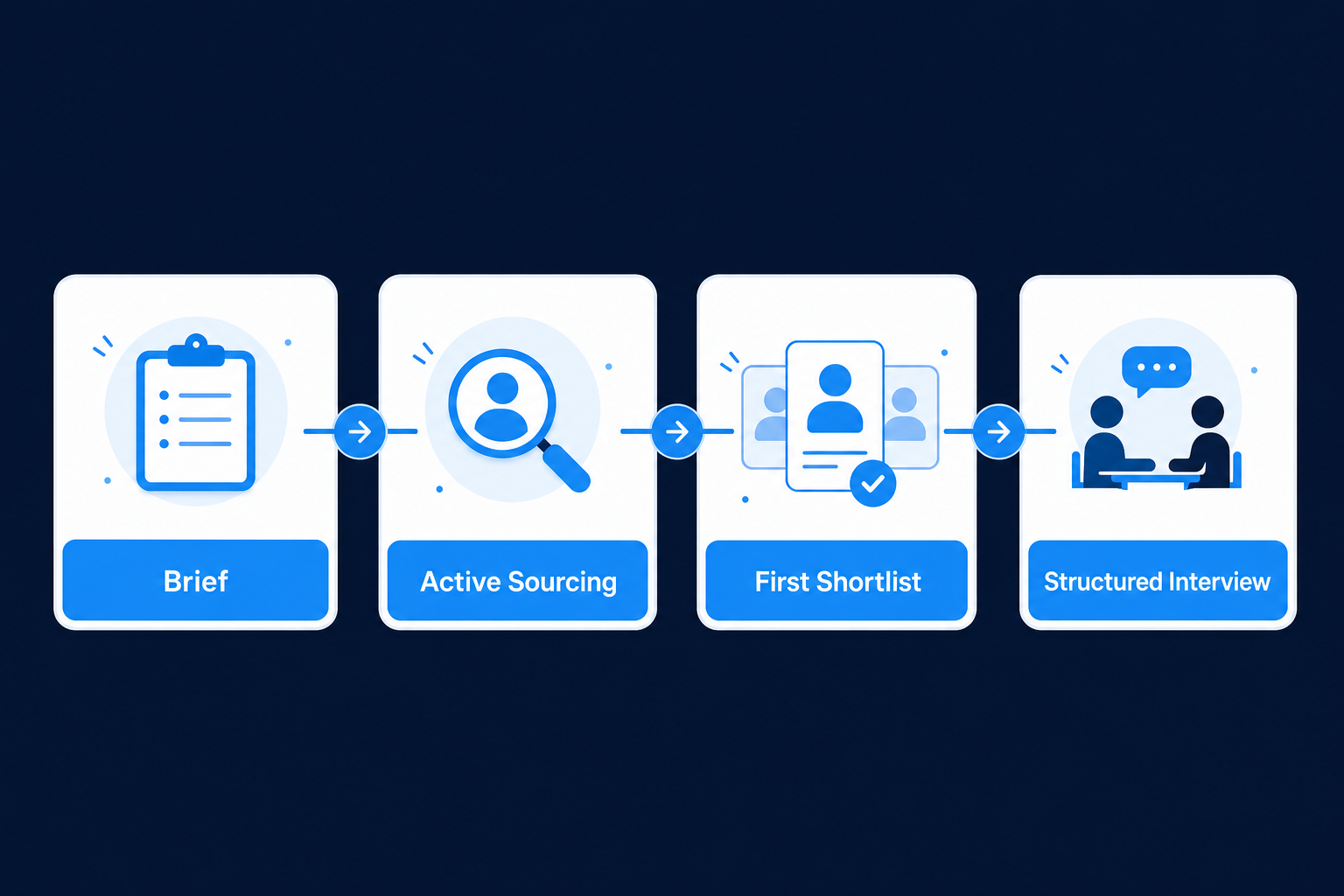
At Bluebird, every GTM search starts with a proper brief session. That means pressure-testing the role scope, the sales motion, the company stage, and the compensation structure before we source a single name.
The team comes from SaaS operator backgrounds, which means conversations about deal motion, ramp expectations, and ICP clarity start from a shared vocabulary. That changes the quality of what goes into a shortlist and the quality of the advice we give when a search is not going as planned.
What the Assessment Process Covers
When we screen a GTM candidate, the evaluation is structured around the specific dimensions that matter for your role, not a generic competency framework.
For an AE, that means ACV alignment, sales cycle length experience, inbound versus outbound split, and stage fit.
For a customer success hire, it means retention economics fluency, expansion motion experience, and procurement navigation capability.
For a senior GTM leader, it means track record of building a repeatable motion, not just inheriting and scaling one someone else built.
Coverage Across the GTM Spectrum
Bluebird covers the full go-to-market hiring spectrum from SDRs through to VP Sales, CRO, and country-level leadership.
For companies entering Australia from overseas and building their first APAC commercial team, we also bring local market knowledge on compensation, candidate expectations, and the specific talent dynamics that differ between Sydney and Melbourne.
The tech scale-up guide covers more of the strategic sequencing decisions that shape how a company builds out its Australian GTM function. It is worth reading before you decide which role to open first.
If you are building a GTM team in Australia or preparing for an APAC market entry, book a strategy call here. We respond within one business day.
Frequently Asked Questions
What does a GTM role include in a SaaS company?
GTM roles cover all commercial functions tied to revenue: sales development representatives, account executives, customer success managers, revenue operations professionals, and sales leadership.
Scope and sequencing vary significantly by company stage. A pre-Series A company needs different GTM hires than a Series B business with an existing motion.
How long should a GTM shortlist take to produce in Australia?
For a well-defined role with a clear brief, a strong shortlist typically takes two to three weeks in the Australian SaaS market.
Poorly defined briefs extend that significantly, because the sourcing filter is too broad to generate a targeted list quickly. The brief session is where the search timeline is really determined.
What is the biggest mistake in SaaS GTM hiring?
Matching on product category or industry vertical rather than deal motion.
A candidate with the right company logo but the wrong motion fit rarely succeeds, regardless of their quota history. Stage fit and sales motion alignment are the two criteria I treat as non-negotiable on every brief.
How do Australian SaaS salaries compare to global benchmarks?
Australia sits below US SaaS OTEs at most levels but above UK equivalents in many senior roles.
Positions with enterprise exposure, APAC leadership scope, or AI-selling capability command a meaningful premium above base benchmarks. The 2026 SaaS Salary Guide has city-by-city and stage-by-stage breakdowns for every core commercial role.
Why use a specialist for GTM recruitment in Australia?
The senior GTM talent pool in Australia is small, largely passive, and concentrated in two cities.
Specialist recruiters with active SaaS networks reach those candidates faster and with more credibility than generalist agencies or job board postings. The quality of the brief-taking conversation also changes when the recruiter has operated in the same environment they are recruiting for.
When should a SaaS company hire its first GTM leader versus its first IC hire?
Hire an individual contributor first if the repeatable motion has not been proven yet.
A VP of Sales brought in before you have a defined ICP, a working sales process, and at least some pattern of repeatable revenue will spend their time building what should already exist. That is the wrong use of a senior hire. Get to repeatability first, then bring in leadership to scale it.
About the Author
James Bergl is Co-Founder of Bluebird Talent, a SaaS and AI recruitment agency operating across Australia and APAC. He has spent over ten years placing GTM, sales, and revenue leadership talent at software companies from pre-seed through publicly listed. Before founding Bluebird, James held commercial roles inside SaaS businesses across the Australian market.
Hiring a GTM role in Australia and want to pressure-test the brief first? Start the conversation here.